
I think it’s an understatement to say that Iceland is paradise for photographers, as I have found no other single island that offers the variety of scenic wonders that I find here (if you know of one, please share, and I will add it to my bucket list).
In August, my good friend and excellent photographer, George Fellner (link) and I joined a photo trip to Iceland that was led by Loren Fisher (link). This trip was a lot of fun and filled with amazing photography opportunities (there are a lot of images still to edit).
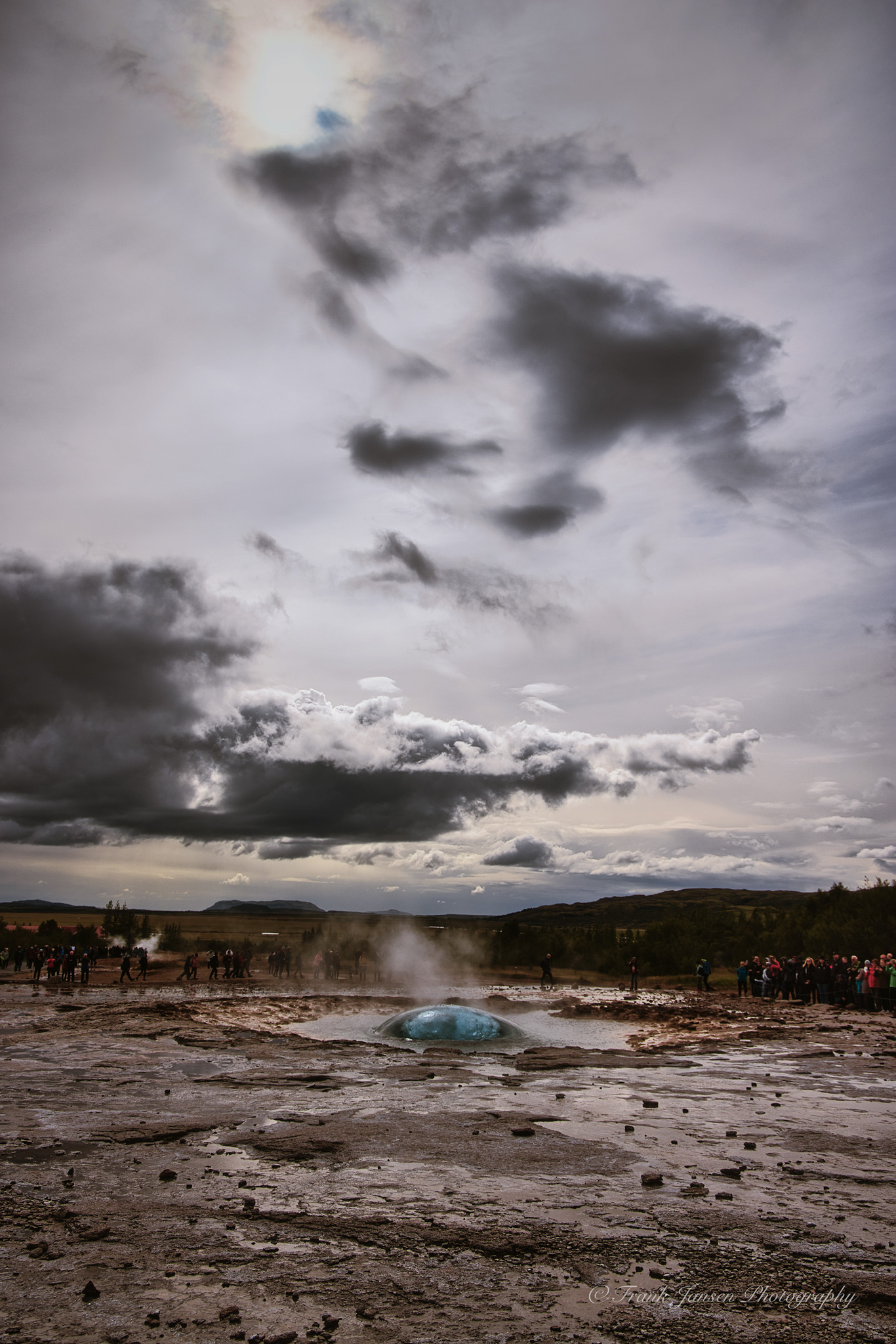
One of the iconic bits of Icelandic scenery that I was lucky enough to capture is the geyser Strokkur (Icelandic for ‘churn’), which you can see in this eruption sequence.


Strokkur has been around for quite some time, as it was first described in 1789, when an earthquake unblocked a conduit, so that the geyser could manifest itself. Even though its activity was rather variable it was active throughout the entire 19th century until at the beginning of the 20th century, Strokkur’s conduit was blocked once again by another earthquake. It remained inactive until its conduit was reopened in 1963; this time it was done with human assistance.
Since the 1963 re-plumbing, Strokkur has been very reliable with eruptions every 6-10 minutes and producing a typical height from 15-20 meters.
During our visit to the site, I witnessed 5 or 6 eruptions and noticed that some might be quite a bit smaller than others. As I was trying to predict the exact time of eruption, I built up a sense of the surface tension that builds up just before Strokkur lets go; it is almost as if the earth is taking a number of breaths in order to have enough air to propel the geyser. At the split second before eruption, a large bluish bubble rises up, which then explodes upwards, as you can see in the photo sequence.
The photo sequence of the eruption is was shot using my Canon EOS R5 camera and a Canon RF 24-105mm f/4 L IS USM lens. The sequence was taken in aperture priority mode with an f-stop of 6.3 and 100 ISO; the resultant shutter speeds were in the 1/1000 to 1/1300 second range.



Leave a Reply